Detection engineering without live malware
Generate benign files that match YARA rules.
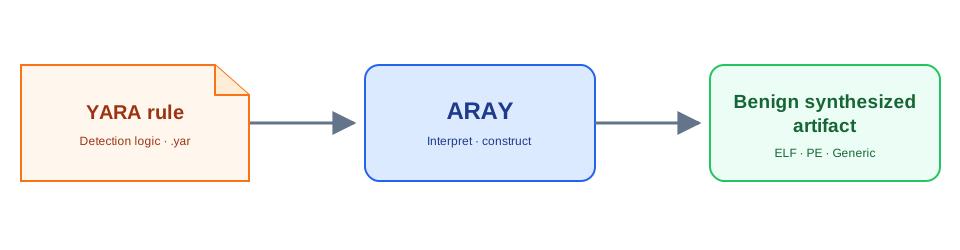
Aray parses supported detection logic deterministically, uses LLM assistance only when needed, and constructs inspectable Linux ELF, Windows PE, and format-specific artifacts with conventional engineering backends.
Black Hat USA 2026 Selected for Arsenal
416
Selected public source entries
97.6%
Positive-fixture yield in full-compile mode
406
YARA matches in the current baseline
3
Artifact families: ELF, PE, generic
Why Aray
Testing security controls with live malware creates avoidable risk, operational overhead, and handling requirements. Aray generates non-malicious artifacts that satisfy static YARA conditions without reproducing the malicious behavior of the samples those rules describe.
Use the artifacts to exercise:
- scanner and alert pipelines;
- incident-response and recovery automation;
- detection-rule validation;
- controlled false-positive and alert-volume experiments;
- research into YARA normalization and autonomous cyber defense.
Research prototype
Aray implements a useful subset of YARA and uses probabilistic models for rule interpretation. Always verify generated output with YARA and use it only in authorized testing environments.
A Narrow Trust Boundary
Aray interprets
Complex rules may be normalized and judged by an LLM. Deterministic canonicalization restores retained fixed values, constructibility preflight rejects known terminal constraints, and supported strings, modifiers, placements, counts, and endian-aware integer checks are extracted directly into Pydantic models. Extraction uses a model only for syntax outside that subset.
Conventional code constructs
Python, assemblers, linkers, and direct binary writers own byte encoding, offset placement, header construction, constant patching, and filesize constraints.
YARA verifies
The batch evaluator invokes the real YARA CLI. A valid model response or a successful build does not count as success unless the resulting artifact matches.
read + select rule -> optional LLM normalize/judge
                  -> deterministic constructibility preflight
                  -> deterministic fixed-evidence extraction
                  -> PE / ELF / generic construction
                  -> YARA verification
Quick Start
The shortest path uses scan-only mode. It writes a minimal scanner artifact directly, without GCC or MinGW.
$ git clone https://github.com/c2dc/aray.git
$ cd aray
$ uv sync
$ cp .env_example .env
$ uv run aray data/rules/rule0.yar --scan-only
$ yara data/rules/rule0.yar build/linux/app
rule0 build/linux/app
Requirements are Linux, Python 3.12+, uv, and the YARA CLI. Rules that require normalization or extraction fallback also need access to an OpenAI-compatible model; Aray supports fully local model execution through Ollama.
Configure models and providers Browse focused examples
Deterministic Backends
| Target | Construction strategy | Output |
|---|---|---|
| Linux ELF | GNU assembler sections and a linker script, or a direct minimal ELF64 writer | build/linux/app |
| Windows PE | MinGW with offset-aware two-pass placement, or a direct minimal PE64 writer | build/windows/app.exe |
| Generic | Direct byte-blob writer preserving format magic at offset zero | build/generic/output{ext} |
Generated sources and normalized rules remain available in the build directory for inspection. The model never emits C, assembly, linker scripts, PE headers, or complete binary data.
Published Evaluation
Aray was evaluated end to end in two stages over 416 selected source entries from the Yara-Rules community repository. The first stage used Aray's own normalization workflow; the second froze those accepted outputs before deterministic realization and YARA scanning.
| Aray stage | Result | Model-dependent path |
|---|---|---|
| Normalization | 416 / 416 accepted | 234 normalized; 182 pass-through |
| Full-compile-mode realization, 1 worker | 406 / 416 matches (97.6%), 10 preflight dispositions | 0 |
Every frozen input bypassed normalization in the second stage because Aray had already performed it in the first. The 406 constructible entries used deterministic string and constant extraction, while seven unsupported pe.* rules, two infeasible whole-file hash preimages, and one unsatisfiable integer value stopped at capability preflight before extraction. There were zero unexplained mismatches and zero construction failures, giving 406/406 conditional realization.
The extraction role was configured in separate realization-stage controls as GLM-5.2, Qwen 3.5, Phi-4, and GPT-4.1, but none of those models was invoked. End-to-end acceptance is an identifier-restricted YARA match against each associated upstream original rule. The result measures workflow completion, not provider quality or universal implication between predicates.
Review the methodology and collection breakdown Download the validation summary
Research Team
Aray is a project of Lab-C2DC - Laboratory of Command and Control and Cyber-security at the Aeronautics Institute of Technology (ITA). It is part of a research collaboration among ITA, the University of Sao Paulo (USP), iFood, and Texas A&M University (TAMU).